

Zero Waste Period
Menstrual cups for better hygiene and waste reduction
55+
Awareness camps held
1300+
Women engaged
50+
Villages reached
Background
Single-use sanitary pads can contain up to 90% plastic, along with many different types of chemicals added for absorbency, fragrance, and a whiter appearance. An average woman menstruates for nearly 40 years of her life and may use around 20 pads per cycle, leading to prolonged exposure to these toxic substances while also generating a significant amount of menstrual waste.
In Ladakh, disposable pads are the most commonly used menstrual product, and they are usually disposed of by burning or burying them. Many women cannot afford the recurring cost of purchasing pads and therefore resort to rudimentary homemade cloth pads, which are often unhygienically maintained. Options such as reusable (washable) cloth pads and period underwear are also not entirely practical in Ladakh, as water scarcity makes washing difficult and the extreme cold prevents proper drying. In many remote communities, menstrual hygiene products are not even available, leaving women to fend for themselves. Considering the region’s environmental and climatic challenges—menstrual cups appear to be one of the most suitable options for women and girls.
Objective
The Zero Waste Period programme is guided by two key goals: making menstruation healthier and more manageable for women, and reducing the large quantities of menstrual waste that pollute the fragile environment of Ladakh.
We reach out to women and girls across Ladakh, especially in rural areas, with comprehensive education on menstrual cups, and we provide menstrual cups at subsidised costs so that interested women and girls are able to make the switch from disposable pads to reusable cups as easily and immediately as possible.
While there are several initiatives in Ladakh on menstrual health for women and girls, most of them promote reusable cloth pads or disposable pads, with the primary goal of menstrual hygiene management. However, these solutions are not environmentally sustainable. Our Zero Waste Period programme, on the other hand, advocates the use of menstrual cups, which can last up to 10 years thus eliminating menstrual waste and, being made of silicone, are not known to have adverse effects on the body.
Activities
We collaborated with the local authorities—the Rural Development Department—for the project. They drew up an outreach roster on the basis of Blocks and Panchayats so that we were able to cover each and every village of the districts. Based on the outreach roster, we reached out to the respective Block Development Officers and the Sarpanchs (village heads), who helped us schedule and conduct the awareness camps in their villages. In this way, we were able to cover villages one by one and ensure a good turnout of women and girls due to the involvement of community leaders.
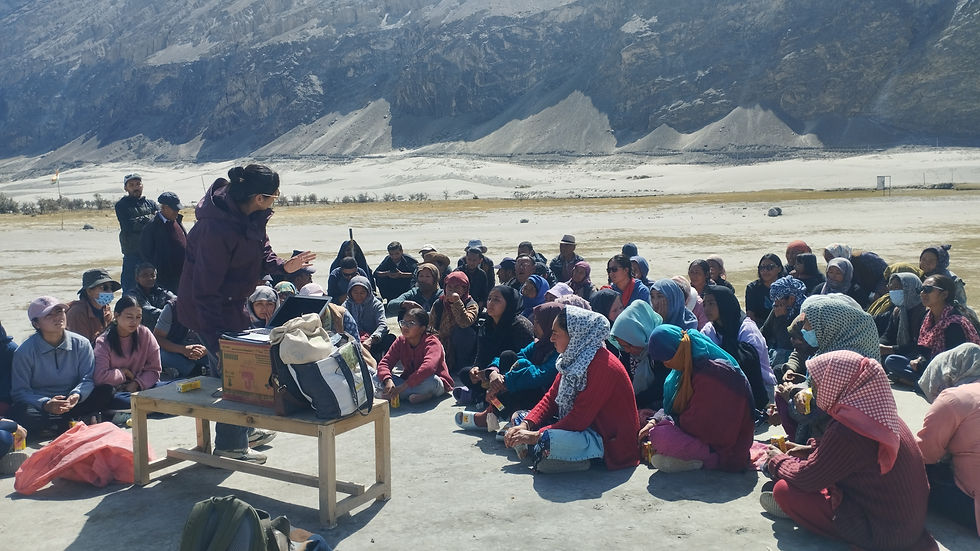
At the awareness camps, we provide education about the biological process of menstruation and the harmful effects of pads on health and the environment. We also spread awareness about menstrual cups as a hygienic and environment-friendly alternative and make them available on the spot.
Impact
So far, under the project, 55 awareness camps have been held across 50 villages in Leh District, reaching approximately 1,300 women. Of these, around 1,200 chose to purchase menstrual cups during the camps at a subsidised cost of USD 1.2 each.
The Way Forward
We plan to conduct awareness camps in all villages across Ladakh, including both Leh and Kargil, as well as in schools and colleges in the region. We envision a Ladakh where menstrual waste is no longer a waste management challenge.
Map
Map showing 50 villages covered under the Zero Waste Period project in Leh District of Ladakh.

Gallery
References
-
Sanitary waste management in India: Challenges and agenda, https://www.cseindia.org/sanitary-waste-management-in-india-challenges-and-agenda-11282
-
Landscape of menstrual products in India, https://www.wateraid.org/in/sites/g/files/jkxoof336/files/2022-03/Designed%20Version%20-%20Menstrual%20Product%20Landscape.pdf
-
Wrapped in secrecy: Toxic chemicals in menstrual products, https://ruralindiaonline.org/en/library/resource/wrapped-in-secrecy-toxic-chemicals-in-menstrual-products/
-
Menstrual hygiene management: Informed product choice and disposal, https://www.wateraid.org/in/sites/g/files/jkxoof336/files/informed-product-choice-and-disposal_1.pdf
-
Menstrual waste management, https://www.wateraid.org/in/sites/g/files/jkxoof336/files/menstrual-waste-management.pdf
-
Menstrual products and their disposal, https://toxicslink.org/wp-content/uploads/2022/08/Menstrual%20Waste%20Report.pdf